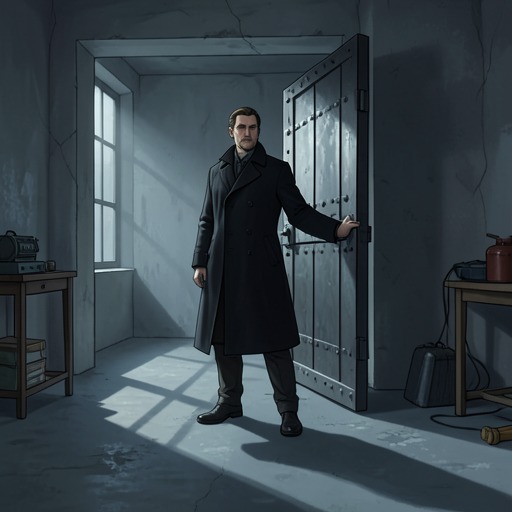
Hoffmann Security Office
Three SecondsHoffmann Security Office is the Vasagatan 42 premises of Hoffmann Security AB, an apartment in central Stockholm converted into an office. When Ewert Grens enters it with keys supplied by Nils Krantz, he recognizes the security company as a front for the Eastern European mafia. The location makes the contrast between a respectable business and concealed criminal activity tangible: behind a carefully appointed apartment are the offices and weapons associated with the firm at the center of his inquiry.
Location and Setting
The office occupies a building in central Stockholm dating from the early twentieth century, from a period when the cityscape was changing dramatically. Its street address is Vasagatan 42. From the apartment’s window, Grens can see Kungsbron and the Vasa theatre, placing the premises amid the ordinary urban life of the city.
The interior retains the character of a well-appointed apartment: shining parquet, high ceilings, and white walls. What had apparently been a drawing room has been turned into an office. Two gun cabinets stand beside an open fireplace, a detail that complicates the room’s polished domestic appearance without concealing its function from Grens.
Discovery During the Investigation
Grens comes to the building after turning the question of the prison and explosion into a question about the person whose death he feels responsible for. Outside the door, Nils Krantz gives him a set of keys and leaves him time to think. Grens uses them to enter Hoffmann Security AB’s premises, making the visit an investigative step as well as a personal reckoning.
Inside, the office helps Grens reassess the apparent drug-crime case. He recognizes the familiar arrangement of a security company serving as a front for the Eastern European mafia. The business’s ordinary, lawful appearance is therefore not incidental scenery: it is the cover that allows a criminal organization to present itself through a legitimate company.
Function and Significance
The premises bring together two forms of concealment that recur in the investigation: a criminal operation hidden behind a lawful institution, and a private, apartment-like interior repurposed for business. The office is neither a remote lair nor an openly criminal storefront. Its central address, refined rooms, and corporate identity make the disguise credible, while the gun cabinets and Grens’s recognition of the firm expose what that disguise serves.
As a place Grens enters with borrowed keys, the office also marks a shift from pursuing fragments of a case to examining the material setting of the organization behind them. The room’s outward respectability and its concealed role mirror the wider divide between official appearances and facts withheld from ordinary scrutiny.